runpoint.home
Command Palette
Type to search. Press Enter for the top match.
A show and catalog

The Upside.

Ways AI is improving the world, backed by specific, sourced evidence.

Most public AI conversation is speculation, split between hype and doom. The Upside is the third thing: real examples of progress.

46 entries2016-2025Social channels
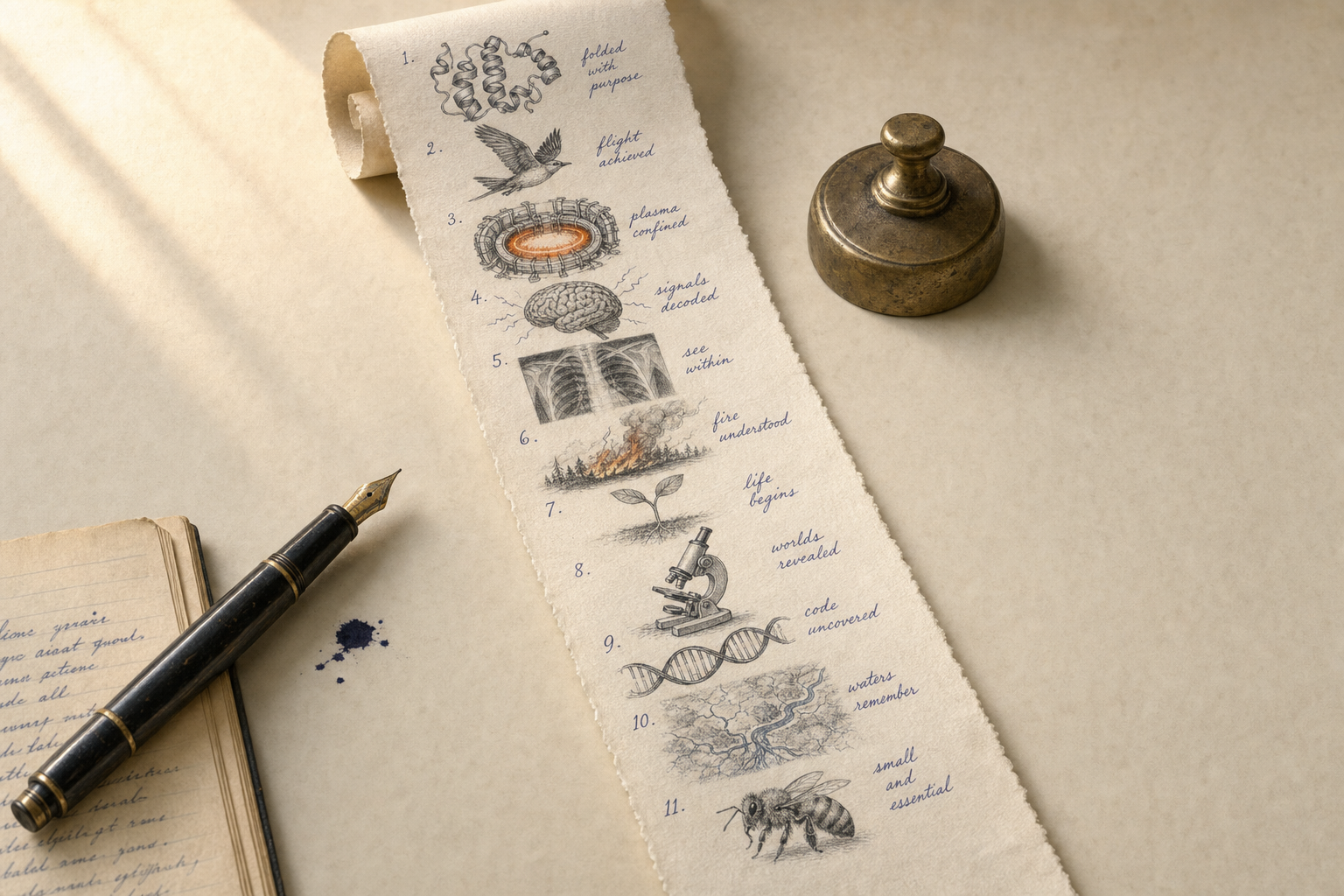
A long paper receipt of hand-drawn AI breakthroughs

Why this exists

The show, the catalog, and the clips all start from the same rule: optimistic claims still need receipts.

I run an AI-native consultancy. I see AI doing specific, measurable, surprising things every week, and almost none of it surfaces in the public debate. The Upside is my attempt to track the places where AI is already making the world a little better.

Sam Gaddis, founder, Runpoint

46
Total entries
11
Sectors
2016
Earliest
2025
Most recent

Filter by sector

Showing 46 of 46

Most recent · Health2026

AI co-clinician answered 97 of 98 primary-care queries with zero critical errors

Zero critical errors in 97 of 98 primary-care queries; matched PCPs on 68 of 140 consultation areas

Google DeepMind's AI co-clinician, evaluated on 98 realistic primary-care queries, recorded zero critical errors in 97 of them. In randomized telemedicine simulations, the system performed comparable to or exceeding primary care physicians on 68 of 140 assessed consultation-skill areas. Multi-country research collaboration spanning the US, India, Australia, New Zealand, Singapore, and UAE. Research-stage, not yet clinical deployment.

  1. Energy2026

    AlphaEvolve lifted a grid-optimization solver from 14% to over 88%

    GNN solver feasibility rose from 14% to over 88% on AC Optimal Power Flow

    Google DeepMind's AlphaEvolve, a Gemini-powered coding agent, evolved an improved training pipeline for a Graph Neural Network solver applied to AC Optimal Power Flow problems. The model's ability to find feasible solutions rose from 14% to over 88%. The same AlphaEvolve impact post lists wins in genomics, infrastructure, and logistics, but the grid figure is the most concrete public-good number.

  2. Safety & Security2024

    AI-equipped lookouts cut wildfire response time

    20+ minutes faster than first 911 call in documented incidents

    Pano AI's camera-and-vision systems are deployed across nine western US states including California, Oregon, Washington, and Colorado, plus Canada and Australia. The platform now monitors nearly 20 million acres and has spotted almost 100,000 fires, catching ignitions that would otherwise stay invisible to humans for hours. In Washington's Jackson Road Fire, Pano's alert shortened response time by at least 20 minutes.

  3. Health2022

    AlphaFold helped solve a malaria vaccine candidate's structure

    AlphaFold2-supported structural characterization of Pfs48/45

    Oxford researchers combined crystallography with AlphaFold2 predictions to determine the full-length structure of Pfs48/45, a leading malaria transmission-blocking vaccine candidate. AlphaFold2 predictions matched the experimental architecture of the central and C-terminal domains and enabled interpretation of the electron density for the N-terminal domain that had resisted earlier efforts.

  4. Health2025

    AI-read X-rays scaled to millions in underserved regions

    5 million AI-enabled chest X-rays across 20+ countries, including India

    AstraZeneca and Qure.ai completed 5 million AI-enabled chest X-ray scans across more than 20 countries, with implementations in India, Colombia, and El Salvador. The screening flagged roughly 50,000 people with lung nodules high-risk for cancer and referred them for further testing.

  5. Education2025

    AI tutoring in Nigeria delivered 2 years of learning in 6 weeks

    ~2 years of progress in 6 weeks (World Bank RCT)

    A World Bank RCT in Edo State, Nigeria, paired secondary-school students with a GPT-4-based after-school tutor for six weeks. Students who participated gained the equivalent of about two years of typical schooling — among the largest effect sizes in education research.

  6. Energy2024

    AI helped cut lithium use in a battery cathode by 70%

    70% less lithium in a working candidate cell

    Microsoft and PNNL screened 32 million candidate materials with AI to find a solid-state electrolyte that uses roughly 70% less lithium than today's batteries — synthesized and tested as a working candidate cell.

  7. Transportation2024

    Self-driving rides are now safer per mile than humans

    ~82% fewer injury crashes per mile vs. human baseline

    Waymo's published safety data from its commercial rider-only service shows 82% fewer injury-causing crashes and 92% fewer serious-injury crashes per mile compared to the human-driven population baseline in the same cities.

  8. Science2024

    AI-designed proteins moved from algorithm to lab in days

    Functional designed proteins synthesized in days

    RFdiffusion (UW/Baker Lab) and related models design proteins from scratch for a specified function — binders, enzymes, vaccines. Several have already validated in the wet lab, compressing decades of evolutionary search into hours of compute.

  9. Climate & Environment2024

    AI maps air pollution at 500m resolution across 100+ countries

    500 x 500 meter resolution; 100+ countries covered

    Google's Air Quality API combines satellite data, regulatory monitors, and ML inference to publish air quality at 500 x 500 meter resolution across more than 100 countries. That gives cities, schools, and asthmatics access to data previously available only in wealthy metros.

  10. Accessibility2024

    AI voice cloning gave ALS patients their own voices back

    Free personalized voice clones for eligible ALS/MND patients

    Through a Bridging Voice and ElevenLabs partnership, eligible ALS and MND patients submit voice recordings and receive a digital replica of their own voice for their AAC device, so they keep speaking in their own voice instead of a generic synthesizer.

  11. Health2018

    IDx-DR — first FDA-authorized autonomous diagnostic AI

    Detects diabetic retinopathy without a specialist

    IDx-DR was the first AI system authorized by the FDA to make an autonomous medical diagnosis — detecting diabetic retinopathy from retinal photos without requiring an ophthalmologist to review the result. It now screens patients in primary-care clinics that previously had no path to the specialist.

  12. Productivity2023

    AI coding assistants measurably speed up developers

    55% faster completion in a 95-developer RCT

    A controlled study with 95 developers found that those using GitHub Copilot completed an HTTP server task 55% faster than the control group. Multiple follow-up studies have replicated meaningful productivity gains across real engineering workflows.

  13. Agriculture2020

    PlantVillage Nuru diagnoses crop disease offline

    Used by farmers in 40+ countries, twice as accurate as extension workers

    Penn State's PlantVillage Nuru runs on a basic Android smartphone and identifies cassava and maize diseases from a leaf photo without an internet connection. CGIAR reports usage from farmers in more than 40 countries, and the app diagnoses twice as accurately as the human extension workers it was tested against.

  14. Education2024

    Khanmigo gives every kid an AI tutor

    400+ US Khan Academy district partners

    Khan Academy's Khanmigo AI tutor is in active classroom use across more than 400 US district partners, putting one-on-one tutoring within reach of kids whose families can't pay the $80/hour private rate.

  15. Safety & Security2025

    AI cameras spot California wildfires before 911 calls

    1,668 fires detected in one year, 636 before any 911 call

    ALERTCalifornia and UC San Diego put AI on more than 1,000 mountaintop cameras across the state. In its first year integrated with CAL FIRE, the system detected 1,668 wildfires, 636 of them before any person called 911.

  16. Health2023

    Sybil predicts lung cancer risk from a single CT

    1-year AUC 0.92; 6-year C-index 0.75–0.81 across three institutions

    MIT/MGH's Sybil model predicts an individual's lung cancer risk up to six years in advance from a single low-dose CT scan. Validated across NLST, MGH, and CGMH cohorts with 1-year AUC of 0.92 and 6-year C-index of 0.75–0.81 — early identification means earlier treatment of the most lethal common cancer.

  17. Conservation2023

    Merlin Bird ID covers 10,000+ species worldwide, 1,000+ by song

    10,315 species in the guide; 1,054 identifiable by Sound ID; free, on-device

    Cornell Lab's Merlin app now covers every continent that has birds, identifying 10,315 species by photo and 1,054 by sound on-device. It turns any smartphone into a citizen-science instrument and feeds one of the largest biodiversity datasets ever assembled (eBird).

  18. Accessibility2023

    Be My Eyes + GPT-4 gave blind users a sighted assistant

    500,000+ blind and low-vision users in the Be My Eyes community

    Be My Eyes integrated GPT-4 Vision into its app the same year it crossed 500,000 blind and low-vision users, giving members instant visual descriptions of anything they point a camera at, from medication labels to airport gates, without waiting for a human volunteer.

  19. Health2023

    qXR reads chest X-rays for TB where radiologists are scarce

    Meets WHO 90% sensitivity target for CAD TB triage; validated across Pakistan, Nepal, Cameroon, South Africa, Tanzania, Zambia

    Qure.ai's qXR is one of the chest X-ray CAD systems WHO recommends for TB screening and triage in adults. Independent evaluations across South Asia and sub-Saharan Africa show qXR meeting the WHO 90% sensitivity target, bringing radiologist-level reads to clinics with little access to one.

  20. Health2021

    Google's dermatology AI covers 288 skin, hair, and nail conditions

    288 conditions identifiable from a phone-camera photo

    Google Health's DermAssist tool draws on a model trained to recognize 288 skin, hair, and nail conditions from three phone-camera photos, then surfaces a ranked list to research further. Useful for the billions of people who live nowhere near a dermatologist.

  21. Health2023

    AlphaMissense classified 71M protein variants

    89% of all possible missense variants classified

    DeepMind's AlphaMissense classified the likely pathogenicity of 71 million missense variants — 89% of the entire human missense possibility space — giving clinicians and researchers a starting point for thousands of rare-disease investigations.

  22. Energy2016

    DeepMind cut Google data center cooling energy 40%

    40% reduction in cooling energy

    DeepMind applied reinforcement learning to optimize cooling in Google's data centers, cutting energy used for cooling by roughly 40% and total energy overhead by ~15% — applied at hyperscale, this is a real climate dividend.

  23. Energy2022

    RL agent learned to control fusion plasma

    Held novel plasma configurations on the TCV tokamak

    DeepMind trained a reinforcement-learning agent to control the magnetic-coil settings of Switzerland's TCV tokamak, holding plasma in shapes that human engineers had previously hand-tuned over years. A real step toward AI-controlled fusion.

  24. Accessibility2023

    Brain-computer interface restored speech for an ALS patient

    62 words/minute — 3× prior BCI record

    Stanford researchers implanted microelectrode arrays in Pat Bennett, who had lost her ability to speak from ALS. An AI decoder converted her brain signals to text on a screen at 62 words per minute — more than three times the previous BCI record and approaching natural conversation speed.

  25. Climate & Environment2023

    GraphCast beats the world's best weather model

    Beats ECMWF on ~90% of variables; runs in <1 min

    DeepMind's GraphCast outperforms the European Centre for Medium-Range Weather Forecasts (ECMWF) — the gold standard — on roughly 90% of forecast variables, while running in under a minute on a single TPU instead of hours on a supercomputer.

  26. Science2025

    Gemini Deep Think hit gold-medal level at IMO 2025

    Officially graded gold-medal score

    A year after AlphaProof's silver, an advanced Gemini Deep Think system officially achieved gold-medal standard at the 2025 International Mathematical Olympiad — the rate of progress in formal mathematical reasoning is now measured in single years.

  27. Science2024

    AlphaProof + AlphaGeometry 2 hit silver-medal level at IMO 2024

    28/42 points, silver-medal-equivalent score

    DeepMind's AlphaProof (formal proofs in Lean) and AlphaGeometry 2 solved four of six 2024 International Mathematical Olympiad problems, including the hardest problem of the contest, scoring 28 of 42. That is equivalent to a silver-medal score. AI systems are not eligible for official IMO medals, but this was the first system to reach that scoring threshold.

  28. Science2024

    AlphaFold 3 predicts interactions across all of biology

    76% binding poses within 2Å (vs. 38% prior SOTA)

    AlphaFold 3 extended structure prediction to proteins-with-DNA, RNA, ligands, and chemical modifications. 76% of predicted ligand binding poses fall within 2 angstroms of experimental structure — roughly double the prior best specialized tool.

  29. Health2025

    Open-weight AI surfaced a novel 'cold tumor' therapy hypothesis

    Silmitasertib + IFN combination validated in vitro at Yale

    Google DeepMind and Yale's C2S-Scale 27B model (built on Gemma) generated a novel hypothesis that silmitasertib combined with interferon could turn immune-'cold' tumors hot. Wet-lab follow-up at Yale validated the prediction in vitro — a rare example of de novo scientific contribution from an open-weight AI.

  30. Transportation2016

    SURTRAC cut Pittsburgh travel times ~25%

    ~25% shorter urban travel, 40% less idling

    Carnegie Mellon's SURTRAC adaptive traffic-signal system cut urban travel times by about 25% and idling time by roughly 40% in Pittsburgh pilots, with measurable reductions in vehicle emissions.

  31. Climate & Environment2023

    AI sorters doubled PET recovery at Evergreen

    PET recovery doubled

    AMP Robotics' vision-guided sorters doubled PET plastic recovery at Evergreen's recycling facility — turning a major share of what would have been landfill into reusable feedstock.

  32. Conservation2023

    Sharkbook IDs 25K+ individual sharks from photos

    25,000+ identified sharks, 146,000+ sightings

    Sharkbook.ai, built on the Wildbook platform, uses computer vision to recognize individual sharks by natural markings. It has logged more than 25,000 identified sharks across 146,000+ reported sightings, turning vacation photos into population-level conservation data.

  33. Conservation2019

    PAWS helped rangers find ~5× more snares

    ~5× snare detection in field tests

    USC's Protection Assistant for Wildlife Security (PAWS) uses ML to predict poacher behavior and plan ranger patrols. Field deployments in Cambodia and Uganda turned up roughly five times as many snares as patrol routes designed without it.

  34. Conservation2024

    Satellite + ML mapped 'dark' fishing vessels

    75% of industrial fishing previously unmapped

    Global Fishing Watch and partners used ML on satellite imagery to map vessel activity worldwide, revealing that roughly 75% of industrial fishing vessels were not publicly tracked — a major step toward enforceable fisheries policy.

  35. Safety & Security2023

    Visa AI blocked $40B in attempted fraud

    $40B in attempted fraud blocked (FY23)

    Visa reports that its AI-driven fraud-detection systems blocked roughly $40 billion in attempted fraudulent transactions in fiscal year 2023, on top of catching ~80% of enumeration attacks in real time.

  36. Climate & Environment2016

    UPS ORION cuts ~10M gallons of fuel a year

    ~10M gallons of fuel saved/yr (~100k tCO₂)

    UPS's ORION route optimization system uses operations research and ML to plan delivery sequences across hundreds of stops. It is estimated to cut fuel consumption by 10 million gallons annually and avoid roughly 100,000 metric tons of CO₂.

  37. Transportation2024

    Waymo rides cut crash and injury rates vs. humans

    Major reduction in injury crashes per mile

    A peer-reviewed comparison of Waymo's rider-only autonomous miles against human-driven baselines found large reductions in injury-causing crashes — the kind of result safety researchers spent decades trying to engineer into human drivers.

  38. Health2023

    Mammography AI cut radiologist workload ~44%

    ~44% workload reduction, non-inferior detection

    The MASAI randomized controlled trial in Sweden found that AI-supported breast cancer screening reduced radiologist reading workload by about 44% while maintaining non-inferior cancer detection rates.

  39. Health2024

    AI in colonoscopy boosts adenoma detection ~20%

    ~20% more pre-cancers caught

    Multiple randomized trials and meta-analyses show that AI-assisted colonoscopy detects adenomas at substantially higher rates than standard practice. More pre-cancers caught earlier means fewer cancers later.

  40. Health2022

    TREWS sepsis alerts cut mortality

    Meaningful mortality reduction when acted on promptly

    Johns Hopkins' Targeted Real-Time Early Warning System (TREWS) flags sepsis hours before clinicians would otherwise catch it. A study of 590,000 patients showed reduced mortality when clinicians acted on alerts within 3 hours.

  41. Climate & Environment2024

    Flood forecasts now reach 700M people

    100+ countries, ~700M people (up from 80 countries / 460M)

    Google's AI flood model now issues riverine flood forecasts in more than 100 countries, reaching about 700 million people. That's up from 80 countries and 460 million the prior year, extending lifesaving warnings to ungauged watersheds where conventional models cannot reach.

  42. Energy2019

    ML made wind power ~20% more valuable

    +20% market value of wind output

    DeepMind/Google used ML to forecast wind power output 36 hours ahead, letting operators schedule energy delivery instead of selling it at spot. Result: a roughly 20% increase in the market value of the same wind energy.

  43. Science2023

    AI proposed 2.2M new crystal structures

    380K stable candidates; 41/58 made in 17 days

    DeepMind's GNoME tool predicted 2.2M new crystals, 380,000 of which are stable enough to be promising synthesis candidates. An autonomous lab at Berkeley successfully synthesized 41 of 58 attempted compounds in 17 days.

  44. Health2020

    AI discovered a novel-mechanism antibiotic

    First new-class antibiotic in decades

    MIT researchers used a deep learning model to screen ~100M molecules and identified halicin, a structurally novel antibiotic effective against multi-drug-resistant bacteria. The same approach later surfaced abaucin, active against Acinetobacter baumannii.

  45. Science2022

    AlphaFold mapped 200M+ protein structures

    200M+ structures, nearly all known proteins

    DeepMind's AlphaFold predicted the 3D structures of nearly every cataloged protein, compressing what used to be PhD-decades of experimental work and jump-starting new biology and drug-discovery efforts worldwide.

+
How this gets made

The Upside starts with sourced entries.

One sourced, measurable AI win at a time. This page is the written ledger behind the show. Once a quarter we cut the catalog into a written brief.

Social channels

The Upside channels are being set up. These placeholders mark where the show accounts will live.

Every entry links to a primary source. Spot one that needs updating or correcting? Tell Sam on X.

SYSTEMS: NOMINAL
LATENCY: 12msRUNPOINT V2.0