A normal Wednesday
I worked out, took my wife to breakfast and went to the dentist. Claude Code and Codex moved 16 pieces of work forward around that, and most of my part was checking what they made.
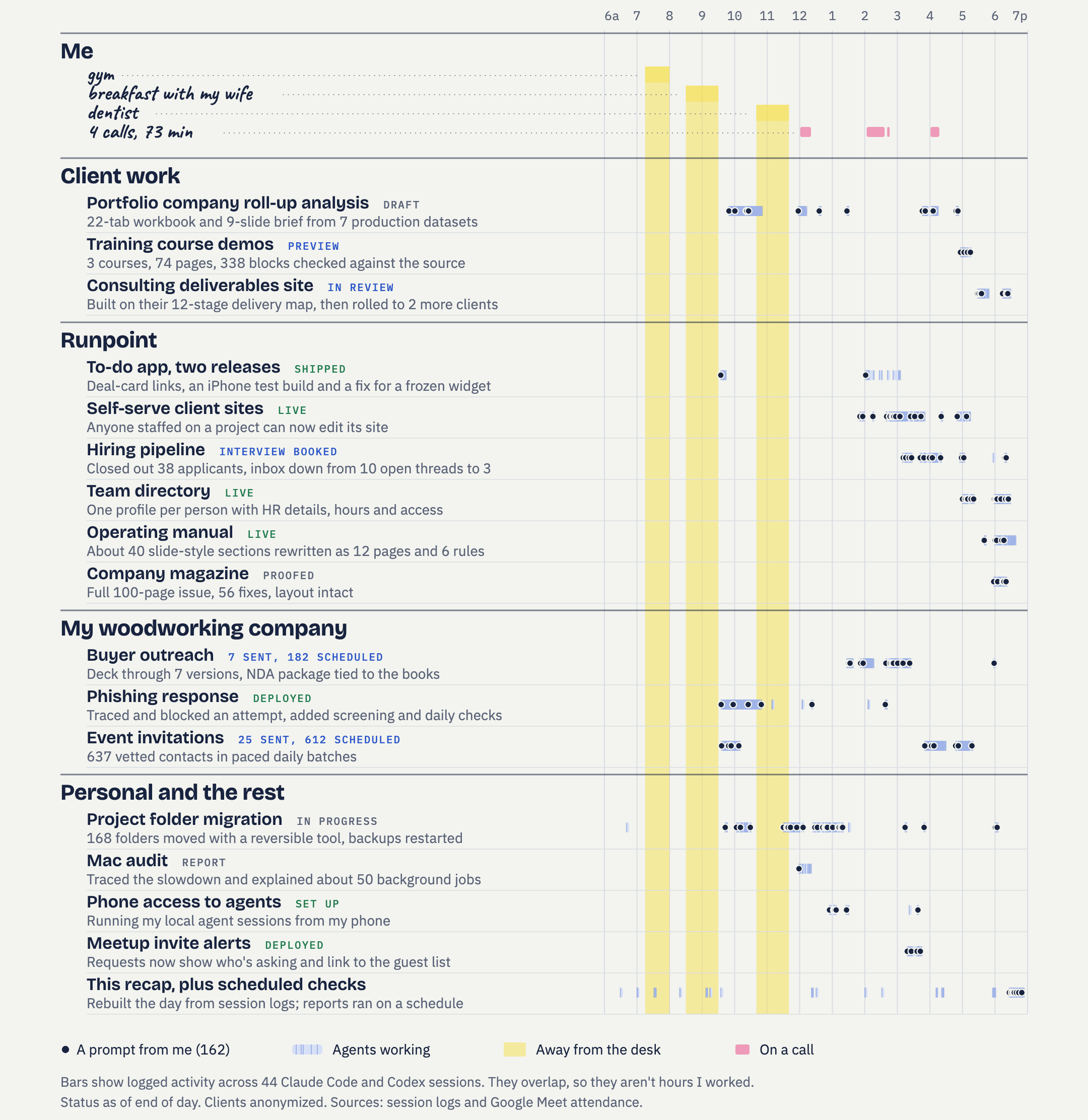
I was at the gym by 7:15 on Wednesday, October 14. At 8:30 my wife and I went to breakfast, which took an hour. I had a dentist appointment at 10:40. Between noon and 4:30 I took four calls. My calendar had set aside 150 minutes for them and they used 73, partly because an introduction booked for 45 minutes was over in four.
That evening I asked Codex to go through every Claude Code and Codex session I'd run that day and reconstruct what got done. There were 44 sessions. Thirteen of them were helpers that a main session had started on its own to take a piece of a larger job. I had typed 162 prompts. When Codex was finished, the list held 16 separate pieces of work for three clients, for Runpoint, for the woodworking company I'm getting ready to sell, and for my own housekeeping. The chart above is that day. My appointments are in yellow, each piece of work has its own row, and every dot is a prompt from me.
I'm writing this down because I think most people don't realize how much one person can now get done in an ordinary day, and that includes a lot of people who use AI every day. Matt Stockton made the same point on X that evening. He said the gap is widening between people who have learned to direct these tools and people who use AI like a search engine. My day wasn't long and it wasn't stressful. I also think the work was the best of my career, and since that's the claim people will doubt, most of this note is about why I believe it.
What moved
For one client, the agents pulled seven datasets from the client's production systems and built a first pass at rolling up results across a group of portfolio companies: a 22-tab workbook and a nine-slide brief, with the gaps marked where the finance data isn't connected yet. For a training company, they put three sample online courses, 74 pages in all, on a password-protected site for review. For a consulting firm, they rebuilt the client's site around its own 12-stage delivery map, added a ranked list of what to do first and cut a planned series of discovery meetings from nine to seven. The template from that site then went out to two more clients.
Inside Runpoint, our to-do app shipped two releases, one of which fixed a widget that had stopped updating three days earlier. Access to client sites now follows project staffing, so anyone assigned to a client can edit that client's site without waiting on me. The team directory became one profile per person. The operating manual went from about 40 slide-style sections to 12 pages. The agents read every new job applicant from three sources, closed out 38 of them and took the hiring inbox from ten open threads to three. They also proofed the full 100-page issue of our magazine and made 56 fixes without breaking the layout.
For the woodworking company, the buyer deck went through seven versions, and the agents assembled a private package for buyers who sign an NDA, with financials that tie to the books. The first seven buyer emails went out. Separately, they traced a phishing attempt to the company's website form and blocked it, and they prepared an event invitation for 637 contacts after checking that the emails would actually land.
Not all of it is finished, and the chart says which is which. Some of it is live. The client work is all drafts and previews for review. Several items are first batches of something larger.
Where my time went
The dots on the chart come in clusters. A cluster is me reading what an agent did, deciding whether it was right and telling it what to do next. My own work was choosing what was worth doing, checking the output against the source, and deciding what was ready to go out. The models did enough of the execution that those decisions got most of my attention. Learning to manage this many agents at once was stressful until I found a rhythm.
The checking is the part I'd point a skeptic toward. When I pushed back on the first version of the portfolio analysis, the agent agreed the data pull had been incomplete and that some of its charts came from scorecards rather than the underlying financials. While revising the buyer deck, the agent flagged a sentence the books didn't support, and we toned it down. Before any buyer emails went out, it compared each of 189 drafts against a backup so that only the sentences I meant to change had changed. The training courses were checked against the client's source material, and 338 text and question blocks matched. One agent working on my file backups told me the backup had finished, then corrected itself when it checked and found it hadn't.
That is why I think the work is better, and the reason is mundane. Checking used to be expensive, so it happened once, on the things that mattered most. Now a second or third pass costs a prompt, so I do far more of it. A deck reconciled against the books is a better deck than one I proofread once, and the difference has nothing to do with my getting better at proofreading.
The slow half
The work moved faster than the people on the other end can take it in. The remaining 182 buyer emails are scheduled one batch a day through October 29, and the sending stops if anything bounces. The event invitations go out at no more than 100 a day, with a review before each batch. The consulting client hasn't seen their site yet. The portfolio brief is waiting on finance data the client expects to connect next week.
At Runpoint we've argued that AI compresses the work of producing things and does much less for the work of getting them adopted. I expected that to describe our clients. It describes my Wednesday too. One person can now produce more in a day than the people around them can review, approve or answer in the same day.
If you want to see your own version of this chart, the reconstruction is the easy part. This is close to the prompt I used:
Review my Claude Code and Codex sessions from today. List the work by project. Separate completed work from drafts, work in progress and blockers. Cite evidence. Don't infer success from a plan. Anonymize clients.