Sovereign Growth.
What do we mean when we say sovereign growth? What are we actually building, and for who? Are we zealots, opportunists, or charlatans? Read on to find out.
We are living through the kind of technological transformation that happens a few times a century. That alone would be radical. That it arrives now, when institutions are decaying, trust is evaporating, and the geopolitical and debt cycles are crescendoing, makes it the biggest thing to happen in our lifetimes.
We see an opportunity.
What sovereign growth means
Sovereignty is having its moment as a word, and it means something different at every altitude. For nations, it means owning the machinery of AI itself: the models, the chips, the data centers on home soil. That is the version Palantir sells, and for its customers it is the right one. For a company, sovereignty is smaller and more useful: you own the way your business runs. The workflows, the data, the encoded know-how of how you operate live in systems you control, and you can swap any vendor, any model, any partner without losing what makes you you. For a person, it is the oldest meaning there is: your work, your judgment, and your upside, under your own direction.
The thread through all three is a destiny you control instead of rent. AI is going to reward initiative more than any technology before it; everyone can already feel that. Sovereign growth is what we call taking that seriously: self-directed, self-governed prosperity. Growth where you get to win. Not Silicon Valley, not the banks, not the multinationals. You.
It rests on three pillars:
- Owned and operated. The control. We mean it three ways at once: we serve owner-operated businesses, where the person deciding owns the outcome. We staff operator engineers, builders who run the work they automate. And we build you a stack you own instead of rent: the critical workflows, the data, the encoded knowledge of how you operate.
- AI-enabled growth. The prosperity. Dramatically more output from the people you already have, measured against numbers you already trust. Ownership without growth is just control; the point is compounding.
- Big swings. The self-direction. The products, services, and markets that were impossible before AI. Sovereignty is not just defending what you have; it is deciding what you become.
Growth is mandatory, the time is now, and it will come from the middle.
- America's debt math only works if productivity growth rises by about half a point. We are not macroeconomists, but we have all seen the charts, and the alternatives (massive tax reform, wealth redistribution, a shifting geopolitical order) all look worse.
- Not from the Fortune 500: committees buy AI and bolt it onto rented systems.
- Maybe from startups. But startups are moonshots by design, and software is now so easy to produce that the old game of building it and selling it is a crowded lottery.
- That leaves the two hundred thousand companies in the middle of the economy. The economists will not tell you that part. It is our claim, and we have staked the firm on it.
- The second reason is timing. Transformations like this do not come around often: electricity got one generation, computation another. This one is ours, and it will not last long. AI lets a small team move nimbly, carrying the compressed intelligence of everything that came before it. There is no excuse left not to build the business of your dreams. We intend to seize the moment, and we invite you to do the same.
The constraint is people, so the firm is built around them.
- Operator engineers: AI-pilled with business sense. Fluent enough in the technology to ship, grounded enough in operations to know what is worth shipping.
- Forward deployed inside your company, with the CEO in the room. Understanding comes before automation, every time.
- The practitioner model: small dedicated teams backed by an on-call network of subject-matter experts. How a five-person firm fights at ten times its weight class.
- Every engagement built to end.
Three doors, in the order most companies walk through them.
After two years in the AI transformation business (an eternity in this world), we have crystallized the offer that works for our market.
Own the plumbing. SaaS replacement. Replace the rented systems that matter with systems you own: ROI positive from the jump, funded by the subscriptions it retires, and it forces a canonical model of how your business actually runs. This was not possible until roughly last December, when the models got good enough at code to make it tenable. They are now. Take advantage.
Own the Plumbing →Own your edge. Model-agnostic agents. Build your Alpha Layer: knowledge, data, workflows, and agents in your infrastructure, with the model as a swappable part. Keep this layer out of the frontier labs' products; that is where lock-in lives. Create data where there was none. Rent the best model each quarter and own everything around it.
The Alpha Layer →Own the future. Exploratory AI. The big-swings door: the new product, the new service, the offer that was unimaginable before. R&D with an owner's discipline.
Own the Future →Owner-operated, roughly $20M to $200M.
There is a clear goldilocks band at play:
- Below the band, ownership rarely pays: too few seats, too little software spend.
- Above it, decades of configuration are sunk into big platforms and committees decide.
- In the middle: spend high enough that ownership pays for itself, configuration shallow enough to escape, an owner close enough to decide.
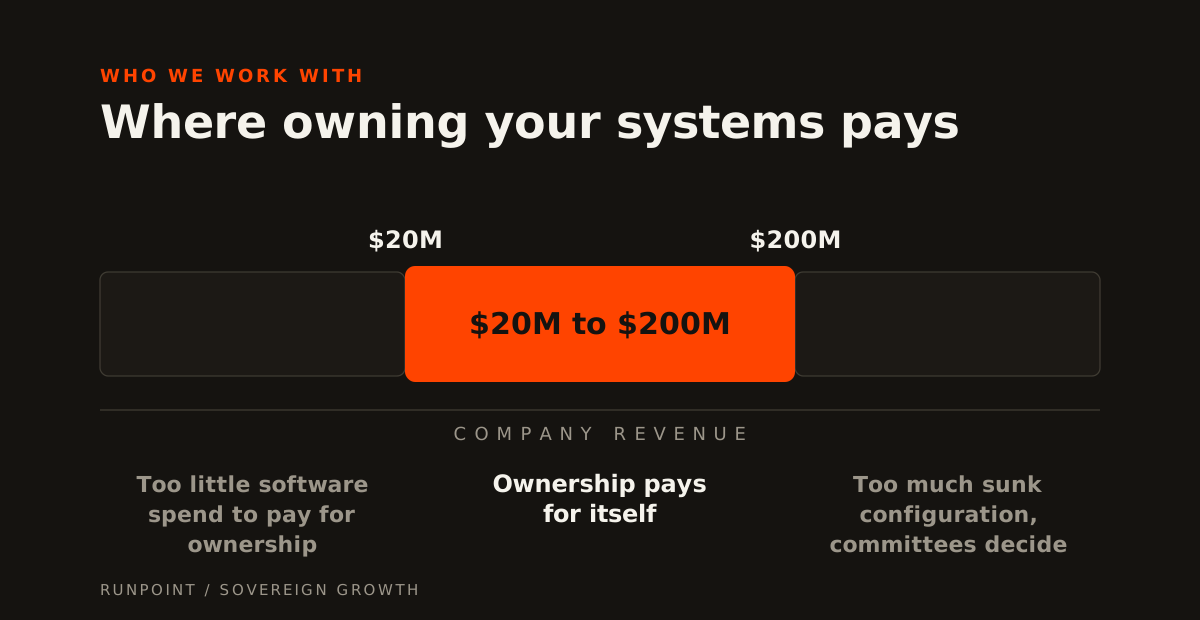
The who and the why are the same argument: the growth lives where the math works.
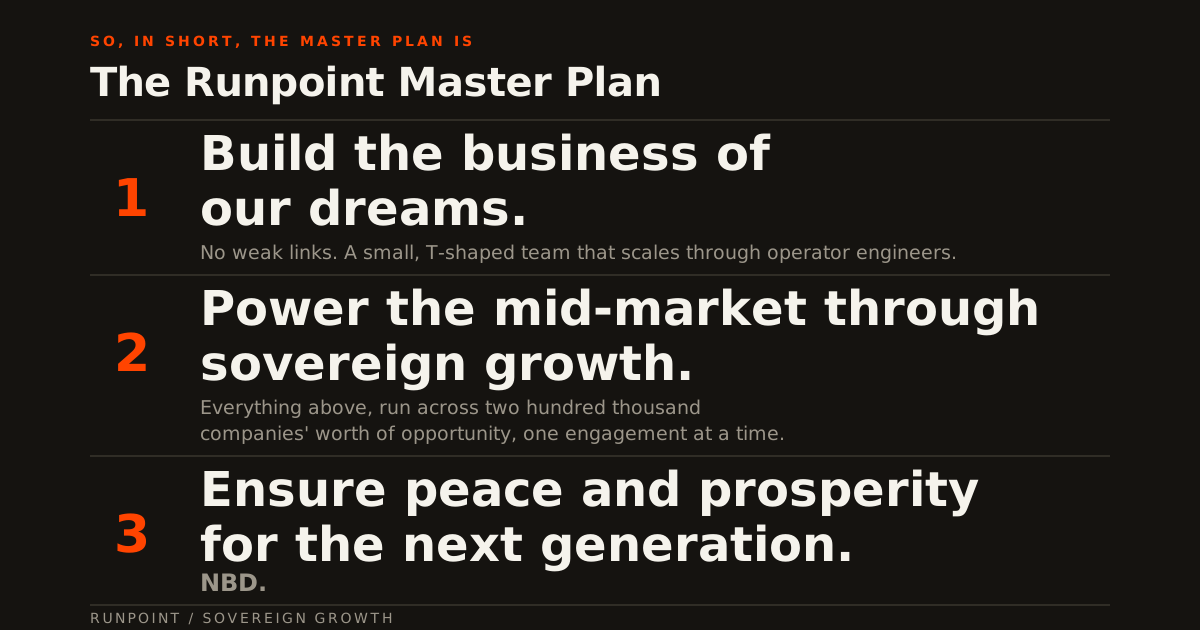
- 1
Build the business of our dreams.
No weak links. A small, T-shaped team that scales through operator engineers.
- 2
Power the mid-market through sovereign growth.
Everything above, run across two hundred thousand companies' worth of opportunity, one engagement at a time.
- 3
Ensure peace and prosperity for the next generation.
NBD.
Engagements start at $40,000 a month.
SaaS replacement can be structured budget neutral. Exploratory work shares upside.
Under every structure: ROI positive, or we walk.
- At one company: sovereignty. Swap any model, any vendor, any partner, including us, without losing what makes you you.
- In aggregate: the half point of growth America needs, built one workflow at a time.
If you run one of these companies: you are not the audience for the AI debate. You are the answer to it. Stop renting your way out of this.
If you are one of the people who ships: there is no more consequential work available to a person with initiative. Come find us.
The Moment is now. Build.