Local Models: When Running AI On Your Own Hardware Is the Smarter Buy
When is running an open-weight AI model on your own hardware the smarter buy, and when is renting the frontier the right call? A practical guide for CEOs.
Most businesses meet AI through an API. You send text to a frontier model over the internet, it sends work back, and you pay by the token. That is the right default for most work, and we use it happily. But it is not the only way to run a model, and for a specific set of workloads it is not the cheapest or the safest one. A local model is the alternative: an open-weight model that runs on hardware you control, inside your own environment, where the data never leaves and the bill does not scale with every request.
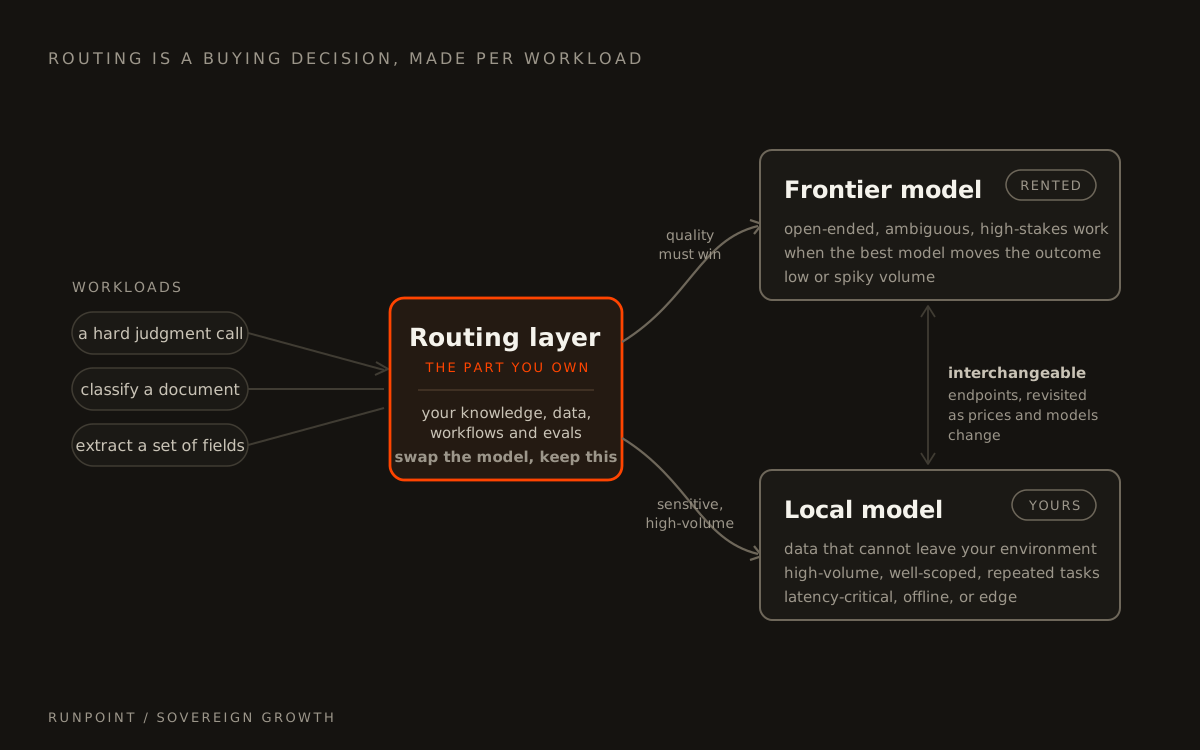
This piece is about when that alternative is the smarter buy, when it is the wrong call, and how to set your business up so the question stays a routine buying decision instead of a bet you can only make once. If you want the larger argument this sits inside, start with the Alpha Layer and Sovereign Growth. Here we go straight to the practical version.
What is a local model?
A local model is an open-weight AI model that you run on infrastructure you control, rather than renting a proprietary model by the token from a lab.
Two words are doing the work. Open-weight means the model's parameters are published, so you can download the model and run it yourself instead of reaching it only through someone else's API. Families like Llama, Mistral, and the other major open-weight releases fall in this category. Local means the machine it runs on is yours to control: physical servers on your premises, or a private cloud instance that is walled off to your account. Either way, the inputs and outputs stay inside your boundary, and you own the cost of the hardware instead of paying per request.
The contrast is with frontier models, the largest proprietary systems from the major labs, which you reach over the internet and pay for by usage. Frontier models are, for most open-ended work, the most capable option available, and they get cheaper and better every quarter. Local models trade some of that ceiling for control over where the data goes and what the marginal request costs. Neither is a moral position. They are two ways to buy compute, and a serious business uses both.
When is local the smarter buy?
Local wins in four fairly specific situations. The clearer your workload sits in one of them, the stronger the case.
Data that cannot leave your environment. If you operate under regulation or a contract that restricts where information can be processed, sending it to a third-party API may be off the table regardless of price. Health information, certain financial and legal data, defense and government work, and customer data governed by a strict processing agreement all show up here. A local model lets you apply AI to that data without moving it across a boundary you promised to hold. The question is whether the data is allowed to travel at all, not whether the lab is trustworthy.
High-volume, well-scoped tasks. Per-token pricing is a rounding error at low volume and a real line item at high volume. When you are running the same narrow task hundreds of thousands or millions of times, classifying documents, extracting fields, tagging records, drafting a templated first pass, the cost of renting frontier intelligence for every call can exceed the amortized cost of hardware that runs a smaller model well enough. Well-scoped is the operative phrase. A task a smaller specialized model handles reliably is a task you may not need to rent the frontier for.
Latency-critical, offline, or edge contexts. Some workloads run where a round trip to an external API is impractical: a factory floor, a remote site, a device that has to keep working when the connection drops, a loop where the round trip itself is the constraint. Running the model close to where the work happens removes the dependency on someone else's uptime and someone else's network.
Predictable, repeated workloads. The common thread across all four is repetition and predictability. A workload you run constantly, whose shape you understand, whose quality bar a smaller model can clear, is exactly the kind of thing that rewards owning the machine. Spiky, unpredictable, or one-off work does not.
When is local the wrong call?
Honesty here is what makes the rest of the argument trustworthy. Local is the wrong call more often than it is the right one.
Frontier-hard reasoning. For open-ended, ambiguous, high-stakes work, where the difference between a good answer and a great one actually changes the outcome, the best frontier model is usually worth it. That is most knowledge work, most of the time. If the quality of the model materially moves the result, rent the best one.
Low or spiky volume. If you are not running enough requests to amortize hardware, owning it is a way to pay for idle capacity. Per-token pricing exists precisely so you do not have to buy a machine to run a workload occasionally. Below the crossover, renting simply wins.
No operations capacity. A local model is infrastructure. Someone has to run it, patch it, monitor it, and swap it when a better open-weight release lands. A team without the appetite to operate that should not sign up for it to save on a bill that may be modest to begin with. The savings are real only if the operating burden is one you can actually carry.
Anything where the best model changes the answer. This is the frontier-hard point stated as a rule, because it is the one people most want to argue with. If a better model would produce a better outcome, that is a reason to keep renting the frontier and revisit later, not a reason to lock in a smaller model to feel more in control.
What does local actually cost?
The two options have different cost shapes, and comparing them means comparing shapes, not sticker prices.
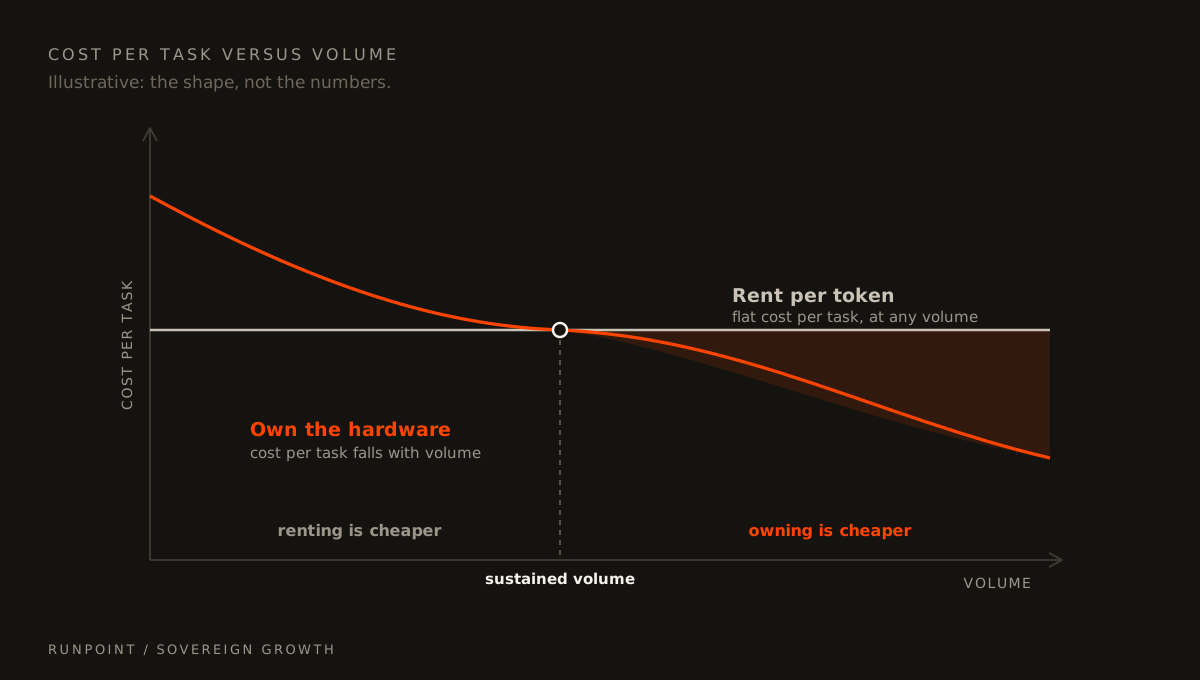
Renting the frontier is a variable cost. You pay per token, so the bill tracks usage: low when volume is low, and rising in a straight line as volume grows. There is nothing to buy and nothing to maintain, and the price per unit has been falling steadily.
Running local is mostly a fixed cost. You buy or reserve the hardware, you carry the operating overhead, and then each additional request is close to free. That means the per-request cost falls as volume rises, because you are spreading the same fixed cost over more work.
Put those two shapes on the same axes and they cross. Below the crossover, renting is cheaper because you never pay for a machine you barely use. Above it, owning is cheaper because you stop paying a per-token toll on work you do constantly. The entire local-versus-frontier cost question is really one question: for this specific workload, at this volume, are you above or below the crossover.
How to stay flexible
Here is the part that changes the whole decision. The mistake is to treat local versus frontier as an identity, something you are, a flag you plant. It is not. It is a routing decision, made per workload and revisited on a schedule.
That only works if the model is a swappable part. If your knowledge, your data, your workflows, your agents, and the evals that tell you whether the work is good enough all live in infrastructure you own, then the model underneath is just a component you can change. The same harness runs a frontier model for the open-ended work and a local model for the high-volume scoped work, and moving a workload from one to the other is a configuration change, not a migration. This is what model-agnostic actually buys you: the ability to change your answer when prices drop or a better model ships, without rebuilding anything around it.
That is why we describe local models as an option, not a philosophy. A company with a real alpha layer does not have to decide once, in public, whether it believes in local models. It routes each workload to whatever is the smarter buy this quarter, checks the routing again next quarter, and moves on. Frontier for the hard and open-ended work. Local for the sensitive, high-volume, or latency-bound work where it pays. The decision stays where it belongs, at the level of the individual workload, revisited as the market moves. Replacing the rented systems underneath so you can own that layer in the first place is the SaaS replacement work that makes all of it possible.
Frequently asked questions
What is a local LLM for business, in one sentence? It is an open-weight AI model that you run on hardware you control, so your data stays inside your environment and you pay for the machine instead of paying per request.
Are local models as good as frontier models like the ones from the major labs? For most open-ended, reasoning-heavy work, the leading frontier models are more capable, and they keep improving. Smaller open-weight models can be more than good enough for narrow, well-scoped, repeated tasks. The right comparison is per workload, not model against model in the abstract.
When does running a model on premises save money? At sustained high volume on a well-scoped task, where the amortized cost of hardware and operations comes in under what you would pay per token to rent the frontier for the same work. At low or unpredictable volume, renting is usually cheaper.
Is local the only way to keep AI data private? No, but it is the strongest answer when data is contractually or legally not allowed to leave your environment at all. When the constraint is that hard, running the model inside your boundary removes the question of what crosses it.
Do we have to choose between local and cloud AI? No. The better setup runs both and routes each workload to whichever is the smarter buy, revisited as prices and models change. That flexibility depends on owning the layer around the model so the model itself stays swappable.