The Three Tests
Three questions a CEO can ask, no consultant in the room, to find where someone else owns a piece of how the company runs. Three yeses is sovereign.
A business is sovereign when it owns the way it runs. Its critical workflows, its data, its permissions, its pace of change, and the encoded knowledge of how it operates all live in systems it controls. It can change anything on its own timeline, and it can walk away from any model, any vendor, any partner without losing what makes it itself.
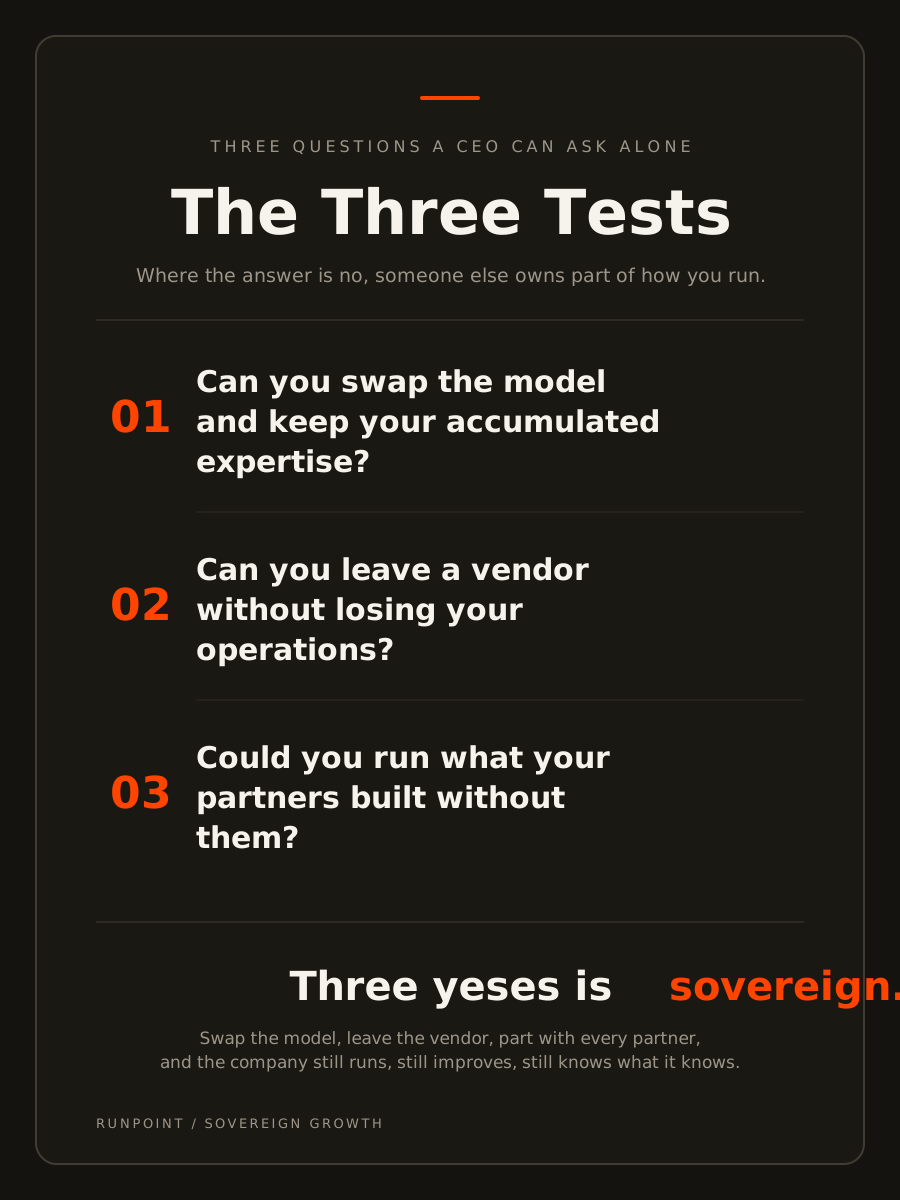
That is easy to say and hard to feel. So here is a way to check. Three questions a CEO can ask without a consultant in the room. Where the answer is no, you have found a place where someone else owns a piece of how your company works.
- Can you swap the model and keep your accumulated expertise?
Satya Nadella made an observation that stuck with us: the frontier model is a generalist, and the value a company builds on top of it is the veteran who has been there twenty years. The generalist you can replace next quarter. The veteran you cannot. So the question becomes whether your company-specific expertise, the SOPs, the evals, the judgment about your business, lives somewhere you can carry from one model to the next. That somewhere is the Alpha Layer.
Picture a company that spent a year making one lab's assistant good. It learned their accounts, their voice, their exceptions. It got genuinely useful. Then a better model shipped, cheaper and sharper, and none of that accumulated understanding could come along, because it was stored inside the first vendor's product. A year of teaching, stranded. That company rented a veteran. It never hired one.
- Can you leave a vendor without losing your operations?
The mid-market risk is rarely a lab reading your data. More often it is waking up three years in and finding that the tool your business now runs on has raised its price five or ten times, and switching would mean rebuilding operations from scratch. A slow tax, agreed to one convenient integration at a time.
Picture the finance team whose entire close depends on a platform that now costs what a headcount costs, with a renewal date that functions as a ransom note. Leaving is technically possible and practically unthinkable, because the way they work lives inside software they do not own. That is dependency wearing the costume of a product.
- Could you run what your partners built without them?
Including us. An engagement that ends with you needing the people who built the thing did not deliver sovereignty. It delivered dependency with a nicer invoice. The test of good outside work is whether the capability stays in the building after the builders leave.
Picture the firm that bought a beautiful custom system and cannot change a field in it without filing a ticket to the shop that made it. Every improvement is a purchase order. The know-how never moved from the vendor into the company. On paper they own an asset. In practice they rent their own operations back from the people who wrote the code.
What this is not
For a company doing between twenty and two hundred million in revenue, sovereignty does not mean owning GPUs, model weights, or a data center. It does not mean rejecting the cloud or building everything from scratch. Keep the ledger, payroll, and deeply embedded platforms that already work. The point is control over how the company runs, not construction for its own sake.
Three yeses is sovereign. You can swap the model, leave the vendor, and part ways with every partner, and the company still runs, still improves, still knows what it knows. That is the end state at one company, and it compounds: a business that owns the way it runs is a business that can grow on its own terms.